
The craft today
Screen printing or DTF: which one suits you, and why it is not a matter of taste
It is the question we get most often after «how much». The short answer fits on one line: a few flat colours, screen printing; a photograph or a gradient, DTF. The long one has numbers, and one of them surprises even people who already know what each one is. Here it is in full, with what we look at in the workshop before telling you which one your design needs.
8 min read
01
Not a war between techniques
Every week someone asks us for a full-colour photograph in screen printing, or asks why we tell them a design is not worth making screens for. The answer is not a workshop preference. The two techniques do different things, and each does a few of them better than the other.
We are a screen-printing workshop and we like screen printing. But what we want is for you to end up with the t-shirt you had in mind, not the one that gives us more work. So when a design calls for DTF, we do it in DTF and tell you why.
What follows is what we look at, in the order we look at it.
02
Screen printing: one screen per colour
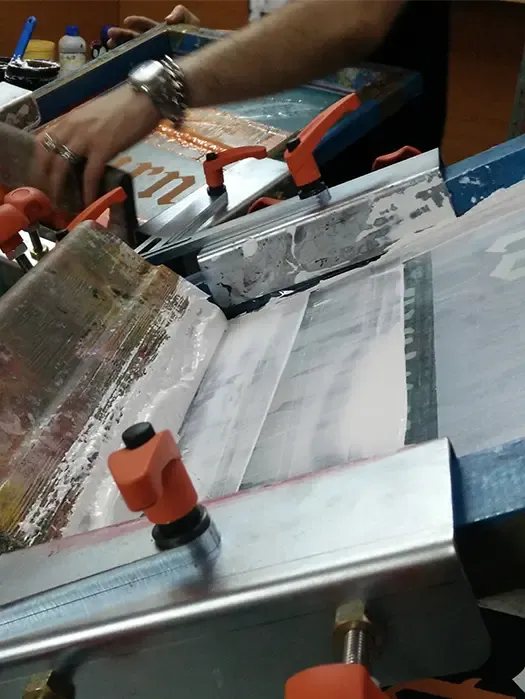
Screen printing is ink pushed through a mesh. Each colour gets its own screen: the artwork is exposed onto it, the mesh is left open where the ink has to pass, and a squeegee pushes the ink onto the garment. One colour, one screen, one pass. It is more than a century old and, in essence, it is done the same way as when posters were printed by hand.
03
DTF: a film, a powder and a heat press
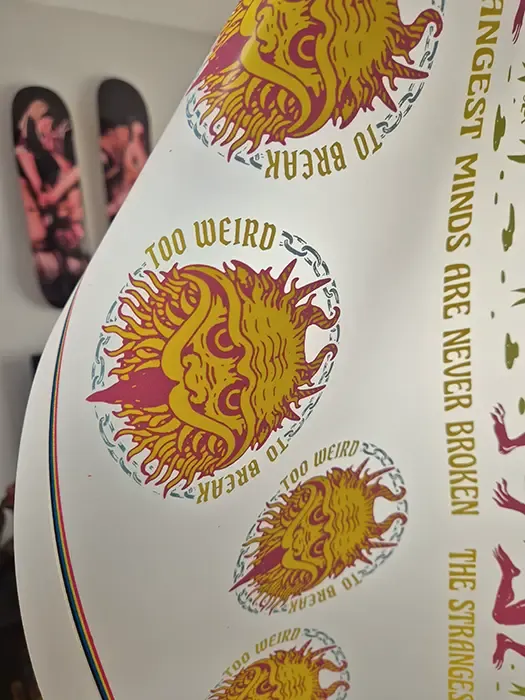
DTF has only spread through workshops in the last few years. The letters stand for «direct to film», and the name gives the trick away: the design is not printed on the garment but on a clear film, in full colour, with a layer of white behind it. Adhesive powder is sprinkled on the still-wet ink and cured, and then a heat press transfers it to the garment. When the film is peeled off, the design stays on the fabric.
The underlying difference is this: screen printing counts colours and DTF does not. In screen printing every colour is a screen, and every screen adds work and cost. In DTF, one colour or a thousand cost the same. What counts is size: the film is used to the last scrap, packed with as many copies as will fit, and a large design takes up more of it than a small one.
04
Where you notice it: the feel
We work with water-based inks, and water-based ink does not sit on top of the fabric: it goes into the fibre. That is why a well-made screen print is barely noticeable when you run your hand over it, and the garment keeps breathing. On dark fabric the colour needs a white base underneath to hold, so the layer is a little more noticeable, but it is still ink inside the fabric.
DTF is a layer on top: ink, white and adhesive, bonded to the fabric. On a small chest logo you will not notice it. On a full back you will: it is a patch that does not breathe and feels cold when you put it on. It is not a defect; it is what it is.
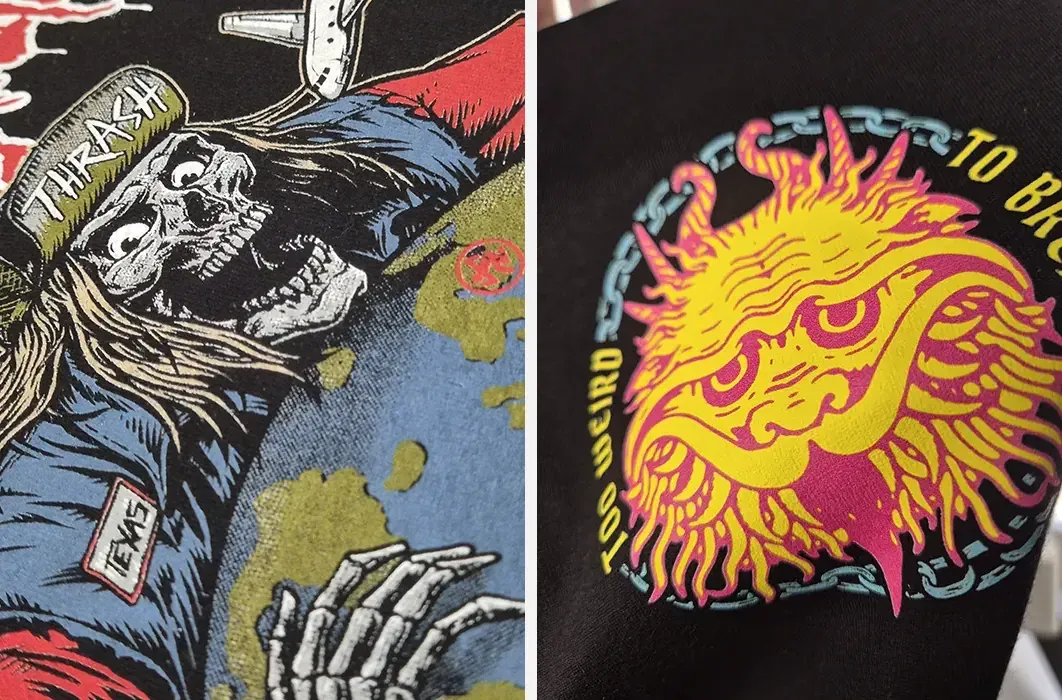
You can see it up close on the cover. On the D.R.I. shirt, screen-printed, the thread of the fabric shows through the colour. On the «Too weird to break» sun, in DTF, none of it shows: the colour is a smooth, even layer, and the edges are razor sharp. Both are well made. They are simply two different things.
The practical upshot: the larger the printed area, the more the difference in feel tips towards screen printing.
05
Where you notice it: colour
In screen printing, each ink is mixed for your design. If your red is a specific Pantone, we mix that red. And some inks only exist in screen printing: fluorescent, metallic and discharge, which instead of adding colour removes it from the fabric and leaves a completely soft feel on dark garments.
DTF prints with four process inks plus white, like a printer. That is why it does effortlessly what screen printing finds hard: photographs, smooth gradients, the skin of a face, a sunset sky. But everything comes out of that mix, and some colours do not fit in it: no fluorescents, no metallics, and some very saturated brand colours (certain oranges, certain greens) come out approximate.
On dark fabric both techniques need white. In screen printing it is one more screen and counts as a colour. In DTF it is always included.
06
Where you notice it: price
This is where intuition goes most wrong, because the two techniques are priced in different ways. And first, a note that applies to this whole section: the prices are approximate. The final price depends on the design and its size, especially with DTF, and we give it to you in writing once we have seen the file.
Screen printing is priced by colours and by position, and when we supply the garment, it is included in the price. There is set-up work (films, screens, registration) that is spread across all the units, so screen printing gets cheaper the longer the run. If you bring the garments, a one-colour print goes from €4.25 per piece at 25 units to €3 at 100, 29% less, because the screens are the same for 25 pieces as for 100. Above 300 units the price no longer comes from the price list: we review the order and give you the best price we can. What moves the price most is the number of colours; the size of the design, less so.
DTF is priced by position and by the size of the design, and colours do not count: a small chest logo does not cost the same as a full back. There are no screens to spread the cost over, so the price per piece barely drops with the run. And it comes on top of the garment: yours, or one from our supplier's catalogue.
Put the two side by side and you get a rule that is worth more than any table: the more units, the more colours screen printing can take before DTF works out cheaper. On a short run, from two or three colours DTF may already be cheaper; on a long one, screen printing keeps winning with more colours. And remember the white base: a two-colour design on a black t-shirt is already three.
That does not mean that once you cross that line you should switch to DTF. It means that from there on you do not choose screen printing for the price, but for what we said above: the feel, the exact colour and the finishes. Some orders are worth it and some are not, and that is what we will tell you when we see the design.
If we supply the garment and you want it in DTF, the configurator does not calculate the order: the workshop reviews it by hand and sends you a quote, instead of inventing a number.
07
Where you notice it: how they age
Both techniques stand up to washing if they are done well. What changes is how they age. Water-based screen printing fades little by little, at the same pace as the garment, like a gig t-shirt from ten years ago. DTF stays the same for a long time, and when it gives, it usually goes at the edges.
With both, washing matters: inside out, cold and no tumble dryer, and the t-shirt will last much longer.
08
When we will say screen printing
When the design is flat shapes, lettering or a logo, with few colours. When the run is a few dozen pieces or more, which is when the screen work spreads well. When the printed area is large and the garment has to stay a garment. When you need an exact brand colour, or fluorescent, or metallic, or the no-feel finish of discharge.
And when you want the t-shirt to look like the ones you love: most band, local festival or shop t-shirts in your drawer are made this way.
09
When we will say DTF
When the design is a photograph or has smooth gradients and the run is short, or when it has more colours than it makes sense to separate: above 6 per position, screen printing is no longer an option. When the design has lots of colours and the run is short, because that many screens for so few pieces do not pay off. And, as you have just seen, when price is what matters and the run is short.
A photograph can be screen printed too, in four-colour process: four screens, plus the white base on a dark garment, and a halftone dot pattern that, done well, looks very good and has the feel of ink. But it costs more, and it only pays off on long runs. What we will never tell you is to make four screens for twenty pieces: DTF gets you the same photo sooner and for less, and the screens would mean a bigger invoice for us, but it would not be good advice.
010
How we decide
We look at three things, in this order. First, whether the design is a continuous-tone image (a photo, a gradient, a painted illustration) or flat shapes. Second, how many colours it really has, counting the white base if the garment is dark. Third, what the garment has to do: last for years, be a uniform, sell at a merch stall or be given away at a one-day event.
With those three answers, the technique almost always chooses itself. When it does not, we talk it through: some designs gain from being simplified to four inks, and with others that would ruin them.
And not every piece in an order has to go the same way. The t-shirts can be screen-printed and a few hoodies with a photo, DTF. In the configurator you choose the technique piece by piece, in the Printing step.
Numbers to keep handy
- Minimum order
- 25 units per design
- Colours per position
- Up to 6 in screen printing; in DTF, as many as you like
- Screen printing, print only, 1 colour
- €4.25 each at 25; €3 from 100
- DTF
- By position and design size, on top of the garment. Colours do not count
- Long runs
- Screen printing gets cheaper with quantity; DTF does not
- Where they cross
- The more units, the more colours screen printing can take (the white base on dark counts)
- Over 300 units
- Screen printing priced to order, outside the price list
- Fluorescent and metallic
- +€0.50 per piece. Screen printing only
- Discharge ink
- Screen printing only, on dark garments
- Usual lead time
- 10–14 working days from proof approval
- Prices
- Approximate and excluding VAT: they depend on the design and its size, especially for DTF
If in doubt, send us the design
Telling you which technique suits a design takes us a glance, and saves you choosing blind. Send us the file, tell us which garment you want it on, at what size and how many, and we will tell you which technique, why and what it costs, in writing. If you already know, the configurator gives you an approximate figure in three steps.