
History of the craft
Warhol and the Factory: when screen printing went from the sign shop to the auction room
He drew shoe adverts. In 1962 he swapped the brush for a screen, set up a studio lined with aluminium foil and said he wanted to be a machine. Sixty years later one of those prints is the most expensive twentieth-century work ever sold at auction. Here is the part that usually gets skipped: how they were made.
8 min read
01
Advertising came first
Andrew Warhola was born in Pittsburgh in 1928, the son of immigrants from a village in what is now Slovakia. He studied pictorial design at the Carnegie Institute of Technology and in 1949 left for New York with his portfolio under his arm.
He spent the whole of the fifties drawing shoes for I. Miller, along with adverts, book jackets and record sleeves. He won Art Directors Club awards and made a very good living. When he is introduced as the artist who turned advertising into art, the most important part gets skipped: he came from the inside.
His technique back then already announced everything. He would draw a line in wet ink, press a second sheet on top and get a broken line that was distinctive and, above all, repeatable. It is called the blotted line, and it is a way of drawing that thinks about printing rather than about the original.
So when he picked up a screen in 1962, he was not discovering it the way an artist tries out a new technique. It was being used by someone who had made a living producing images to be printed.
02
1962: the screen arrives
One very common misunderstanding is worth clearing up: the thirty-two Campbell's soup cans he showed at the Ferus Gallery in Los Angeles in July 1962 are not screen prints. They are hand-painted, with the outline projected onto the canvas and a rubber stamp for the fleur-de-lis on the label. The screen arrives that same summer, right afterwards.
The change is radical and very concrete: take a press photograph, turn it into a screen with photosensitive emulsion, and you can now repeat it as many times as you like, changing only the colour underneath. First with baseball and banknote images; then, when Marilyn Monroe died in August 1962, with the face everyone had in their newspaper that week.
In 1963, in an interview with Gene Swenson, he produced the line that has followed him ever since: that he painted this way because he wanted to be a machine. It is usually quoted as provocation, and it was, but it is also an exact technical description. Seriality is not a concept bolted on afterwards to justify anything: it is what the tool does once you really use it.
03
The Factory was a workshop, not a metaphor
In 1963 he rented a floor at 231 East 47th Street in New York. Billy Name lined it with aluminium foil and silver paint, which is where the name it is remembered by comes from: the Silver Factory. Everyone passed through, but what happened there was production.
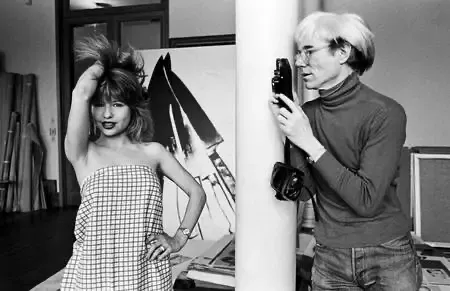
Gerard Malanga, hired in 1963, printed a great deal of that work. And this is not a footnote: a screen over a metre wide cannot be pulled by one person. You need two hands at each end of the squeegee and steady pressure all the way down. Anyone who has printed a large poster knows it immediately.
Warhol did not hide it, he boasted about it: assistants, editions, a signature on the back. The romantic idea of the artist alone at the canvas does not survive five minutes with a screen that size.
That is also where the most imitated detail of his work comes from: flat colour underneath, photographic black on top, and often the black does not land quite where it should. Part of it was a decision and part of it is simply what happens when you print by hand at that scale. Telling the two apart, in his case, is not always easy.
On 3 June 1968 Valerie Solanas shot him at the new Union Square studio. He never fully recovered, and the workshop slowly closed in on itself.
04
The cow, the banana and the poster
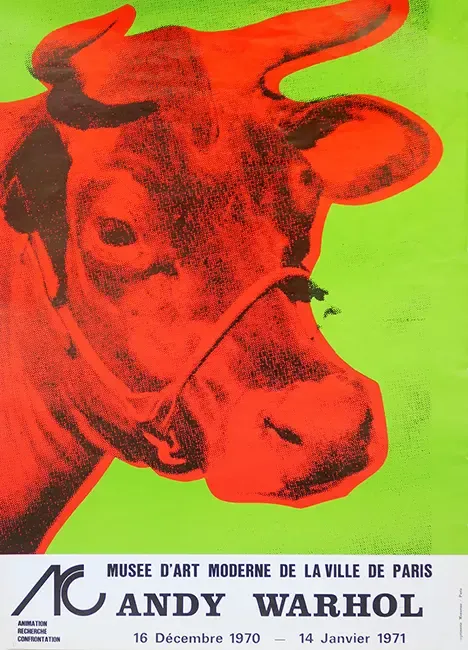
In April 1966, at the Leo Castelli Gallery, he papered an entire room with cows. A single image, repeated, sold by the metre like any other wallpaper. It is the exact opposite of the unique work, and it is the same cow's head that years later would go on the Paris poster at the top of this article.
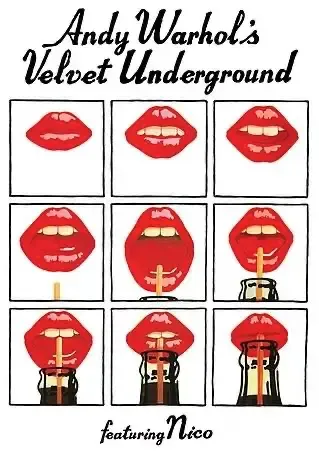
That same year he produced the first Velvet Underground record with Nico, put his name on the cover and made a banana you could peel. The band's promotional poster works just like a print: one drawing, one flat red, a grid and small variations inside each cell.
The Paris poster closes the circle rather nicely. A public museum announces an artist's exhibition by printing his image on paper to hang in the street. Exactly the work he was doing in the fifties, when he was not yet Warhol.
05
Corita and him: the same squeegee, opposite directions
Mary Corita Kent, whom we wrote about in another article in this journal, discovered screen printing the same year, in the same country, and precisely by seeing Warhol's soup cans. Her prints sold for a few dollars so that they would circulate; his sold in numbered editions that ended up at auction.
In May 2022, Shot Sage Blue Marilyn, from 1964, sold at Christie's for 195 million dollars: the most expensive twentieth-century work ever sold at auction. The same technique she used to bring the price of art down, he used to multiply it.
That the tool allows both is the interesting part. Repetition carries no value of its own: value is added by whoever signs. A screen has no idea whether what is passing underneath is an edition of ten or a run of five hundred shirts.
06
What we take from it, at the press
A photograph does not print itself. Either it becomes a halftone or it is reduced to flat shapes, and both are decisions, not automatic steps. Warhol's system — flat colour underneath, photographic black on top — is still the cleanest way to put a face on a shirt with two inks.
Offsetting the inks is a device, but only when you choose it. When it happens by itself it is called bad registration. The difference is who is in charge, and that is the job of a well-tensioned screen and properly placed marks.
And the lesson we use every week: when somebody brings us a photograph, the question is never how do we print this photo, but what has to survive of it when you only have three inks. Warhol answered that question every day, and the answer was always less than what was in the photograph.
Facts worth remembering
- Real name
- Andrew Warhola, Pittsburgh 1928 – New York 1987
- Before art
- A commercial illustrator in New York through the fifties, award-winning and very well paid
- The soup cans
- Hand-painted in 1962; the screen arrives that same summer
- First Marilyn
- August 1962, weeks after the actress died
- The Factory
- 231 East 47th Street, lined with aluminium foil by Billy Name
- Who printed
- Gerard Malanga and other assistants: a large screen needs two people
- The line
- "I want to be a machine", in a 1963 interview with Gene Swenson
- Cow wallpaper
- Leo Castelli, 1966: one image repeated and sold by the metre
- Record
- Shot Sage Blue Marilyn (1964), 195 million dollars at Christie's in May 2022
- Legacy
- The Andy Warhol Museum in Pittsburgh, with the 610 boxes of the Time Capsules
A screen is a production tool
Warhol understood that before anyone else and never pretended otherwise: the point of screen printing is that a well-resolved image can be repeated a hundred times just as well. It is exactly what we do here every day, with shirts instead of canvas. If you have an image and you do not know what will survive with three inks, that is the conversation we enjoy most.