
History of the craft
Screen printing in the street: from May 68 to the rent strike
Every time a lot of people have wanted to say one thing at once, someone has set up a screen in a room and started printing. It happened in Paris in 1968, in Berkeley in 1970, in Gaborone in 1983 and in Barcelona in 2009. It is happening now: at the housing marches across Spain and in the blockaded schools and universities of France this October, what people wear and what they paste on the wall very often comes off a squeegee. Here is why it is always the same tool.
10 min read
01
A printing press that fits in a room
Screen printing has one virtue no other printing technique has matched: it needs almost nothing. A frame with a stretched mesh, an emulsion, a squeegee and a tub of ink. No electricity, no machine weighing a ton, no operator who spent years learning it. It can be set up in a classroom, a union hall or the kitchen of a flat, and if the police knock on the door it can be taken apart and loaded into a car.
That is what sets it apart from offset or lithography, which in 1968 were the serious techniques. Both need plates, chemicals, a fixed workshop and someone who says yes. A screen asks nobody's permission: whoever holds the design can have it printed within the hour, a hundred copies, in one colour, on whatever paper is around.
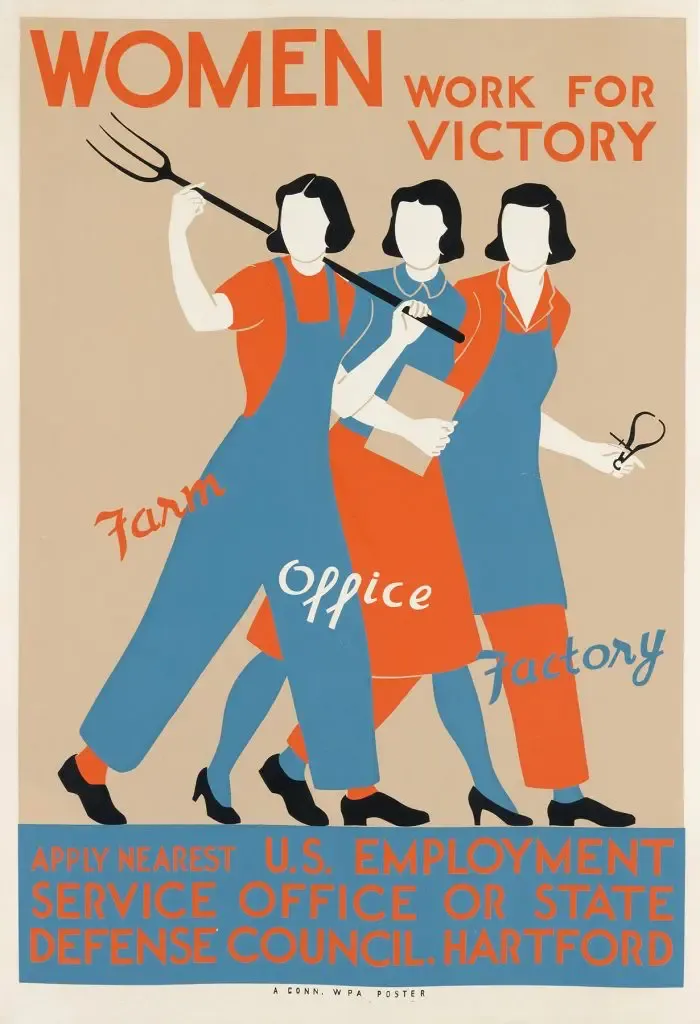
The technique entered public poster-making in the United States in the 1930s, through a state programme. The poster division of the Federal Art Project, part of the New Deal's WPA, switched to the screen because it was the cheapest way to print runs: between 1935 and 1943 it is credited with some thirty-five thousand designs and close to two million posters, of which about two thousand survive today. The one reproduced here, made in Connecticut around 1941, shows the whole mechanism: three flat colours, a ground that is already a colour, and letters you can read from across the street. Anthony Velonis, who ran the New York shop, wrote a technical pamphlet that was sent to art centres across the country and persuaded a generation of artists that what worked for signs would work for them too. Out of that milieu comes the word that marks it as art, serigraph, a credit Velonis asked not to be given.
What happened next is that people with neither a state nor a press discovered the same thing: with a screen they could say what they wanted, as many times as they wanted.
02
Paris, May 1968: the Atelier Populaire
On 14 May 1968, days after the first barricades in the Latin Quarter, students at the École des Beaux-Arts in Paris occupied the school's lithography studio and renamed it: Atelier Populaire. The first posters were made with stencils and litho stones, and the problem showed at once: lithography was too slow for a street that changed every day.
Screen printing arrived through two people: the printer Éric Seydoux and the artist Guy de Rougemont, who had discovered the technique in New York. With the screen, the workshop could run up to two thousand copies of a single poster, in one colour, on cheap paper, with hand-drawn lettering. Work went on at night, printing the designs the day's general assembly had approved by majority: a poster that lost the vote was not printed. None was signed. In the morning, teams of bill-posters took them to the occupied factories and the walls of the neighbourhood.
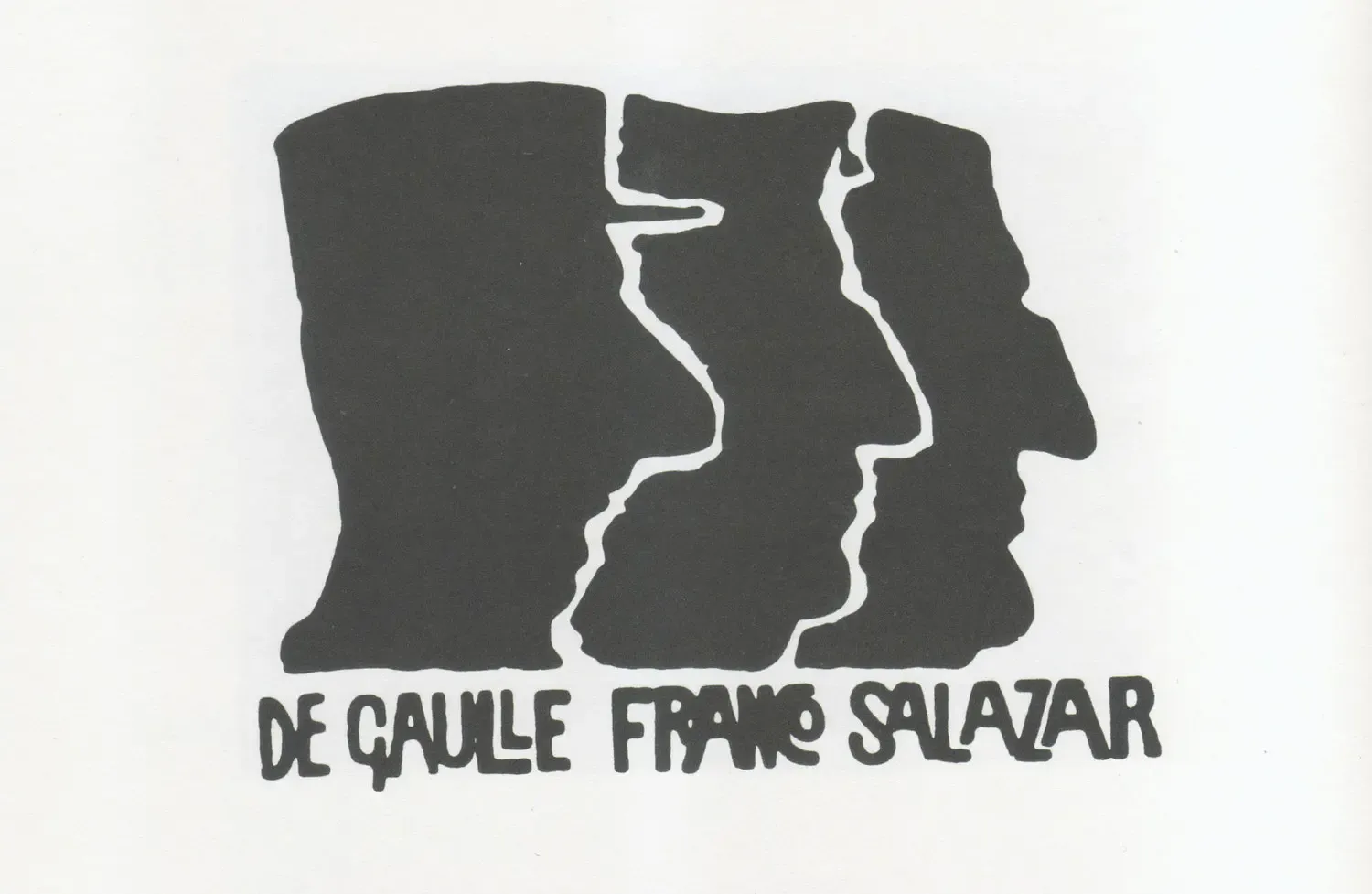
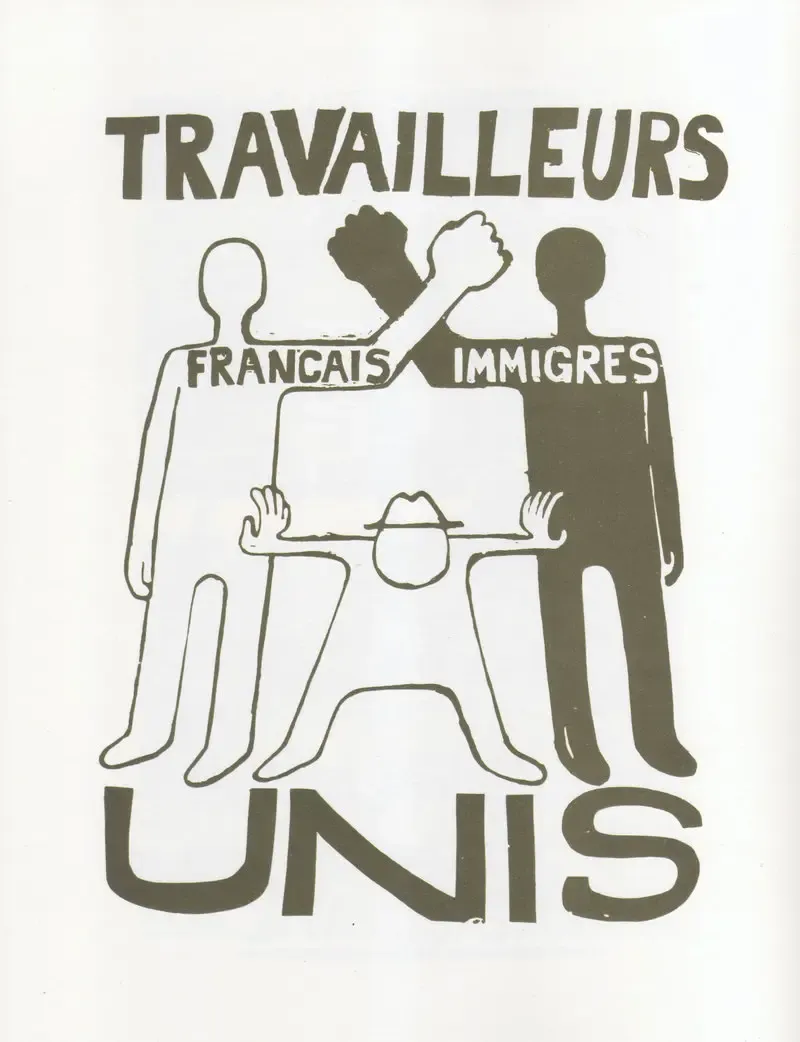
Some of the most reproduced images of the century came out of that room: the general's silhouette with a hand over his mouth and «Sois jeune et tais-toi», the factory whose chimney becomes a fist and «La lutte continue», «Nous sommes tous indésirables» with Cohn-Bendit's face, and «La beauté est dans la rue» with the girl throwing a cobblestone. Two of those reproduced here say a lot about how the work was done: «Travailleurs français immigrés unis», French and immigrant workers united, with two figures raising a fist together over a boss in a hat; and the «De Gaulle, Franco, Salazar» that opens this article, three cut-out profiles and three names, with no further explanation. A few days later, the occupiers of the École des Arts Décoratifs opened their own atelier.
The workshop put in writing what those sheets of paper were. The posters, its statement said, are weapons in the service of the struggle and inseparable from it; their place is in the street and on factory walls, and to use them as decoration, to display them in bourgeois places of culture or to treat them as objects of aesthetic interest is to cancel their effect and turn them fraudulently into collectors' items. That is why none was ever sold. In the early hours of 27 June the police closed the school and took some seventy occupiers away; in six weeks, hundreds of thousands of posters had been printed, over a million by some counts. The Bibliothèque nationale de France holds about seven hundred.
03
Berkeley, 1970: the poster as a class
Two years later, across the Atlantic, the mechanism repeats with one difference: the workshop is inside the university. On 4 May 1970 the National Guard kills four students at Kent State, Ohio, during a protest against the invasion of Cambodia. Days later, at the University of California, Berkeley, students set up the Berkeley Political Poster Workshop, with permission from faculty at the College of Environmental Design to use its facilities.
The workshop was guided by Malaquias Montoya, a leading figure of the Chicano art movement, and within weeks it produced hundreds of screen-printed designs and, by estimate, some fifty thousand copies. Bright colours, big letters, one image per poster. It was the largest of a series of similar workshops that sprang up that spring on the Bay Area campuses.
Screen printing was, in fact, the technique of the Chicano poster: Rupert García, who had started out making posters for the San Francisco State strike in 1968, spent two decades printing images about Vietnam, the Mexican Revolution and life in the barrios, always in a few flat colours. Community shops such as Self Help Graphics in Los Angeles turned the screen into a neighbourhood tool that still works today.
04
Gaborone and Johannesburg: smuggled posters
In southern Africa the screen was literally clandestine. In 1979 a group of South African exiles in Gaborone, the capital of Botswana, founded the Medu Art Ensemble, with units for theatre, music, photography, publications and graphic art. Medu means «roots» in Sepedi. The graphics unit, with Thami Mnyele and Judy Seidman among others, made more than fifty anti-apartheid posters between 1979 and 1985, which were smuggled into South Africa and pasted up at night in the townships.
On 14 June 1985 the South African army raided Gaborone. It killed twelve people, four of them Medu members; Thami Mnyele fell outside his home, the night before he was due to leave for Lusaka. The soldiers took the portfolio with his drawings, and a week later a security police commander showed them on television as evidence of terrorism. They have never been recovered.
Inside the country, the baton passed to workshops such as the Screen Training Project in Johannesburg and the Community Arts Project in Cape Town in the early eighties. Young people from township organisations and civic associations came to make their own posters, and the stated aim was for each community to end up with its own production unit. Thousands of posters, T-shirts, badges and banners came out of them, until police pressure forced the project underground.
05
The banner you wear
A poster is pasted up and stays put; a T-shirt goes home with the person and comes out again the following Saturday. In the eighties screen printing made that leap, from the wall to the body, and the street has not gone back.
In March 1984 the designer Katharine Hamnett went to a reception at Downing Street for the first London Fashion Week wearing a white T-shirt she had made in her office that same day: «58% Don't Want Pershing», in huge black letters, the share of Europeans a poll said rejected the American missiles. She was photographed shaking hands with Margaret Thatcher. One ink, one T-shirt, one photograph: the formula was so simple it has been copied ever since.
Three years later, in New York, six people who met to talk about what the AIDS epidemic was doing to their community designed a poster: an inverted pink triangle on a black ground and the words «Silence = Death». They pasted it around Manhattan before ACT UP existed, and when the group was founded it adopted the design. It moved to the button, the T-shirt and the sticker, and in 1992 hundreds of people wore it at a die-in outside the White House. It is probably the most recognised activist design of the century, and it has exactly what a screen does best: one shape, one colour, one line.
06
Here: from Estampa Popular to the green T-shirts
In Spain, under the dictatorship, the cheap multiple was a way of saying what could not be said. In 1959 Estampa Popular was born in Madrid, the first artists' group to oppose the regime from inside the country through the visual arts, and in under five years it had groups in Andalusia, the Basque Country, Valencia and Catalonia. They worked mostly in linocut and woodcut, techniques you can do at home and repeat by hand, with the idea that a print should cost what a book costs.
Out of the Valencian group, in 1964, came Rafael Solbes, Juan Antonio Toledo and Manolo Valdés to found Equipo Crónica, which made the screen its medium: more than a hundred serigraphs and twenty-eight multiples in seventeen years, turning the imagery of the mass media and of art history against Francoism. There is an idea shared with 1968 worth holding on to: if the work can be reproduced, many people can own it, and if many people can own it, what it says carries more weight.
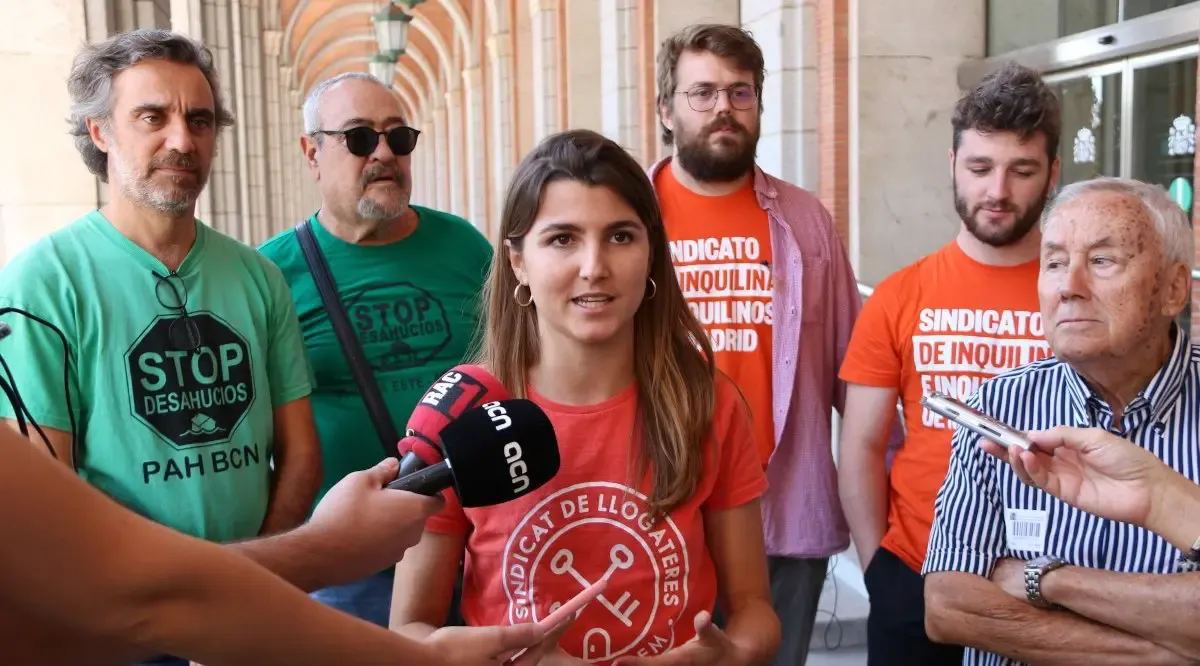
The coloured T-shirt that today identifies a cause from a kilometre away has a date here: February 2009, Barcelona, when the Plataforma de Afectados por la Hipoteca, the platform of people affected by mortgages, was founded. The PAH's green T-shirts, with «Stop Desahucios» and «Sí se puede», were for a decade the image of an eviction being stopped in any city in the country; by 2017 the organisation had two hundred and twenty local assemblies. That same year saw the birth of the Sindicat de Llogateres, the Catalan tenants' union, with a key on the chest and a coral red, and of the Madrid tenants' union, which chose orange. The press conference in the photograph has all three T-shirts at once, and you can tell who is there without anyone saying a word: green for the PAH, coral for the Sindicat, orange for the Madrid tenants. At a march, the red of CCOO and UGT joins them.
07
October 2026: back in the street
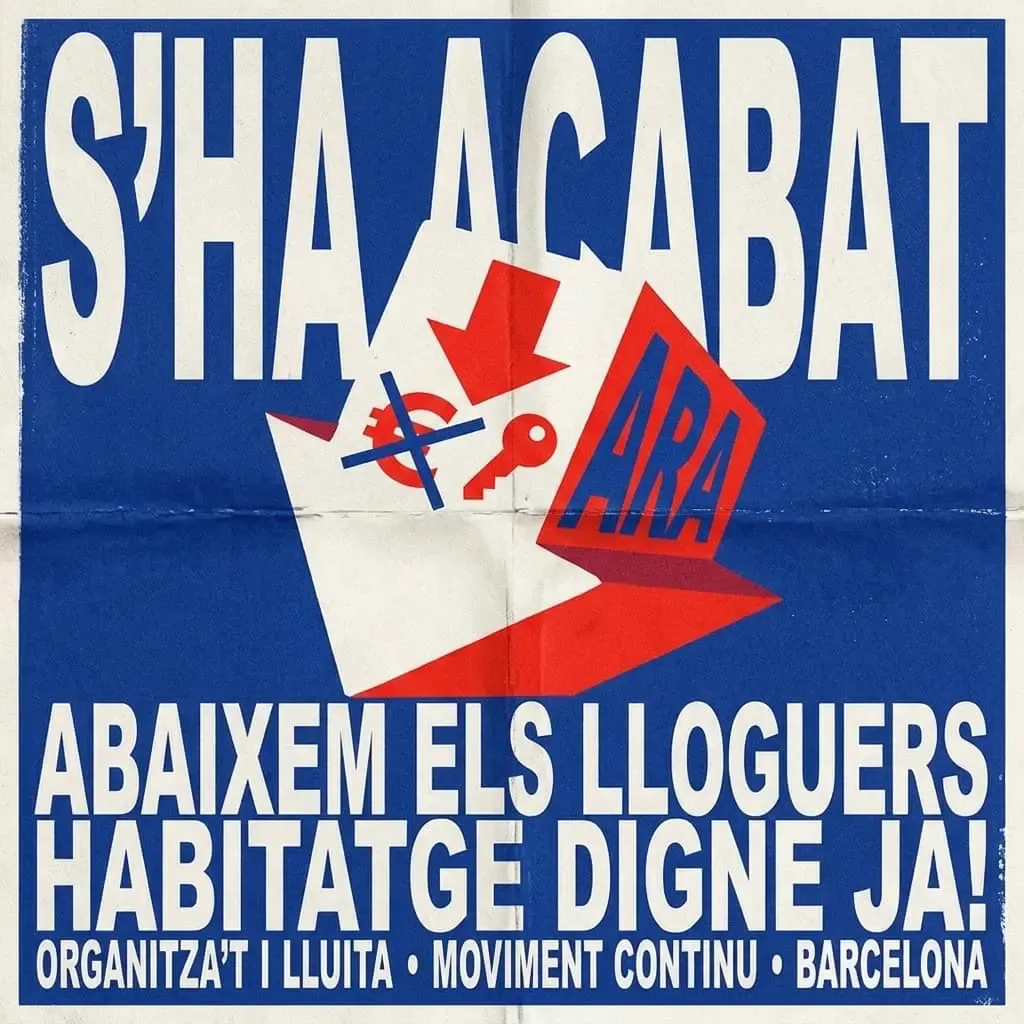
On 23 November 2024 the Sindicat de Llogateres marched through Barcelona behind the banner «S'ha acabat. Abaixem els lloguers» (It's over. Lower the rents): a hundred and seventy thousand people by the organisers' count, twenty-two thousand by the city police's, and a rattle of house keys heard across the centre. On 5 April 2025 the protest was repeated in some forty cities. And on 3 October this year, 2026, the confederation of tenants' unions and dozens of groups filled more than fifty cities at once, with a camp in Madrid's Puerta del Sol and a new slogan already circulating in print: «Ser rentista no es un trabajo» (Being a landlord is not a job). In Barcelona the rain pushed the march to the 5th, and the UGT, CCOO and CGT unions are preparing a general strike for housing this November, the first UGT and CCOO would call together since 2012.
In France, meanwhile, the school year has begun with the lycées blockaded. It started on 18 September with a dozen schools in the Val-de-Marne, took shape around the lycée Saint-Exupéry in Créteil, and by 1 October the student unions counted six hundred and forty lycées and some thirty universities blocked, over unfilled teaching posts, overcrowded classes and buildings in poor repair. On 6 October the national youth march drew two hundred and fifty-six thousand people by the government's count and four hundred and fifty thousand by the organisers', and the movement has crossed into Liège.
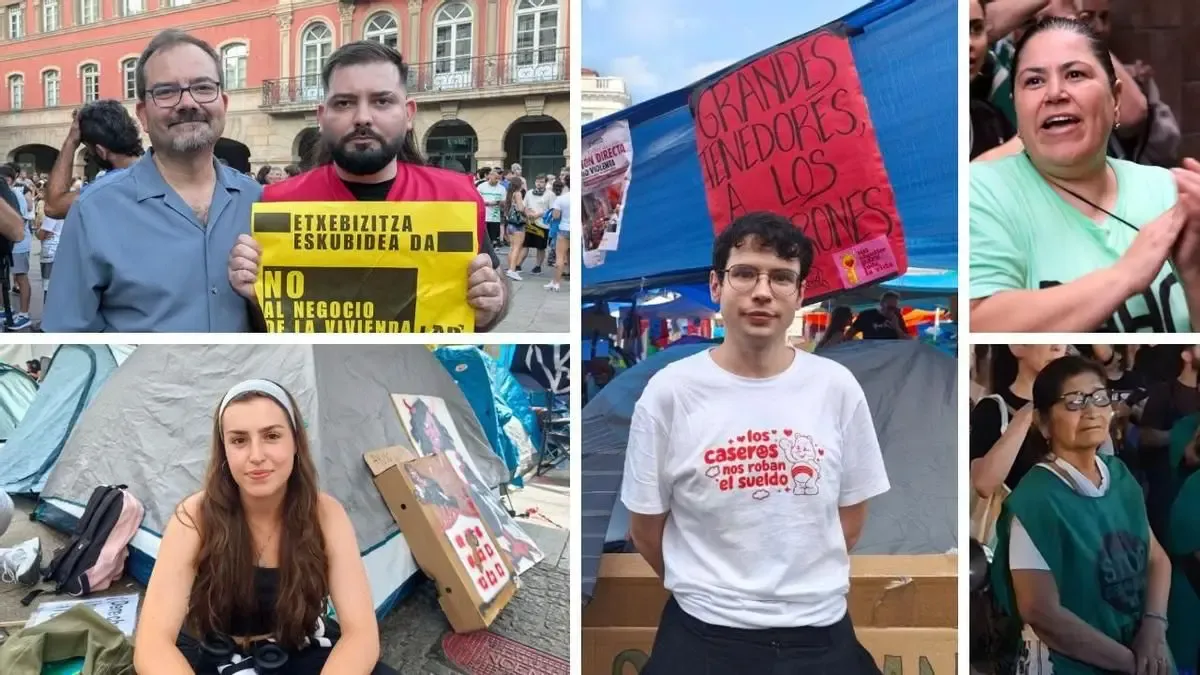
The photographs from this October hold the whole grammar of this article: a yellow two-colour sign reading «Etxebizitza eskubidea da», housing is a right, in Basque; a white T-shirt with a teddy bear and «Los caseros nos roban el sueldo», landlords are stealing our wages, in a single red ink; a hand-painted cloth banner against the big landlords; and the green T-shirts and vests that have been saying who they belong to for more than fifteen years.
08
The same squeegee
The call-out now travels by phone: viral videos, messaging groups, live streams. But once people reach the street the message needs a body, and that has not changed. A banner you can read from twenty metres, a hundred identical T-shirts so everyone knows who is who, a poster that survives a night of rain on the wall. To make two hundred identical things in an afternoon, without asking anyone's permission and without spending more than the cost of the fabric, the screen is still the shortest route. Screenshots disappear; the T-shirt stays in the wardrobe and comes out again.
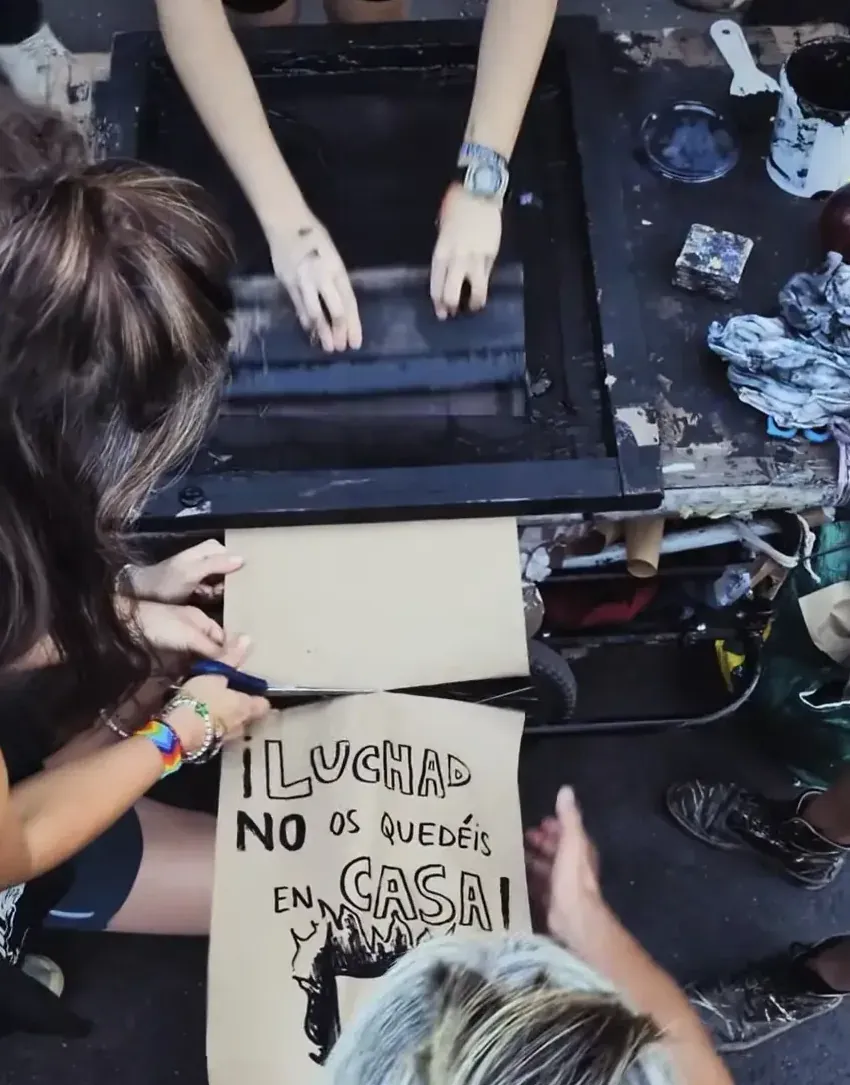
And sometimes the screen comes down into the street itself. At the end of September a video went round of a screen set up on a cart in the middle of the road: one person prints, another cuts the brown kraft paper with scissors, and the poster comes off finished on the spot: «¡Luchad, no os quedéis en casa!», fight, don't stay at home, in one ink, with a house in flames drawn underneath. No workshop and no waiting for anyone. It is the logic of the Atelier Populaire, only in broad daylight and without walls.
That the posters of 1968 are still reprinted, quoted and carried at today's marches says two things: that the designs were good, and that the technique that made them possible is still within anyone's reach.
09
What we take from it, at the press
Put all these posters side by side, from Paris to Gaborone, and you will see they share a grammar. One colour, two at most. A ground that already does the work of a colour. An image that reads from across the street and a short line in big letters. It is not a fashion: it is what comes out when the screen is ready in an hour and every extra colour is another pass. The poster that closes this article, built on the graphics of the 23N march, does exactly the same: white and red on a blue ground that is already a colour, a key, a crossed-out euro, and letters big enough to read from across the street.
It is exactly the advice we give anyone who brings us a design for an assembly, a union, a colla or a residents' association. Contrast before detail. The line, big. A colour that shows on the T-shirt you will actually wear, not on a computer screen. And if the design has to go from the T-shirt to the banner and from there to a poster, make it so it holds up on all three without changing.
The rest is craft: a well-tensioned mesh, a properly exposed emulsion and a squeegee with steady pressure. In 1968 that was done at night in an occupied classroom. We do it by day, in a workshop in Esplugues, with the same squeegee.
Facts worth remembering
- Before 68
- WPA poster division (United States, 1935–1943): some 35,000 designs and close to two million screen-printed posters
- Atelier Populaire
- From 14 May to 27 June 1968, in the lithography studio of the École des Beaux-Arts in Paris
- Why the screen
- Lithography was too slow; the screen gave a hundred copies an hour and runs of up to two thousand
- The workshop's rule
- Designs voted in the daily assembly, unsigned and never for sale: «weapons in the service of the struggle»
- Berkeley, May 1970
- Hundreds of designs and some 50,000 copies in a few weeks, guided by Malaquias Montoya
- Medu, Gaborone
- More than 50 posters smuggled into South Africa (1979–1985); Thami Mnyele, killed on 14 June 1985
- The T-shirt
- Katharine Hamnett facing Thatcher, March 1984; «Silence = Death», New York, 1987
- Here
- Estampa Popular, Madrid 1959; Equipo Crónica, over 100 serigraphs; PAH, Barcelona 2009, green T-shirts
- 23 November 2024
- Barcelona, «S'ha acabat. Abaixem els lloguers»: 170,000 people by the organisers' count, 22,000 by the city police's
- October 2026
- More than 50 Spanish cities on the 3rd; in France, 640 lycées blocked on 1 October and between 256,000 and 450,000 marchers on the 6th
A screen asks no one's permission
Everything in this article was made with the tool we have at the workshop. If you are an assembly, a union, a colla or an association and you need a hundred T-shirts or a banner by Saturday, that is the work we have always done: a clear design, one or two colours, fabric that survives the wash and a written quote. And if you do not yet know what will be left of your design in a single colour, that is the conversation we like best.